
Advisor Perspective
Advisor Perspective
JMG’s Investment Process, Designed Around You (Part 4 – Ongoing Management)

By Bill German, Chief Investment Officer, Principal, CFP® and John White, Principal, CFA, CFP®
This article is the final installment in our four-part series. In the previous articles we discussed the first three steps in JMG’s Investment Process: Client Analysis, Portfolio Design, and Investment Selection. This article will discuss the final step in our process, Ongoing Management, in which your advisor navigates changing economic and market environments, and evolving tax considerations, seeking to optimize your after-tax results.
Ongoing Management
Markets move. Economies evolve. Tax laws change. And of course, your life moves ahead in new and unexpected ways. All these changes create opportunities and risks. Your advisor helps you navigate them. From an investment perspective, this means adjusting your portfolio to help optimize your outcome.
These adjustments take various forms – some are designed to increase returns, others to save on taxes, and others to manage risk. We focus on areas where we have conviction to achieve the highest probability of achieving your goals, and as always, we seek to ensure that our actions firmly support your plan.
Changes to Strategic Allocations
Strategic Allocations is a fancy way of saying “Long-Term Allocation Target.” By their nature, it is important to maintain your strategic allocations over the long term. However, there are circumstances that may justify a change. The most common reason is when there is a change in your circumstances which allows (or requires) you to accept more (or less) risk. In the process of reviewing your plan, your financial advisor will identify these moments and recommend a change.
In addition, there may be times when the JMG Investment Committee makes changes to our recommended mix of asset classes. Though this happens rarely, changes may include increased or decreased allocations to specific assets classes, or the addition or removal of an asset class from base portfolios. We do this to ensure that our process is still aligned with market fundamentals and to give our portfolios the best chance to meet the risk and return expectations of our clients.
Rebalancing
As parts of your portfolio move in different directions and at different rates, it is common for your portfolio to drift away from its original Portfolio Design established earlier in the investment process. When this happens, your advisor will sell holdings which are above their target weights and buy investments which are below their target weights. This is referred to as “rebalancing.”
The primary role of rebalancing is to maintain the level of risk that you and your advisor agreed to in the Investment Policy Statement, which is designed to support your financial goals. Without ongoing rebalancing, portfolios could become increasingly concentrated in certain areas over time, altering the intended return and risk characteristics of the portfolio.
Since equity markets are generally upwardly moving, and benefit from momentum over shorter time periods, it is often prudent to let a portfolio run for a time before rebalancing. Therefore, we frequently monitor asset weightings but have reasonably wide bands to allow advisor discretion to allow your portfolio to move for a time before rebalancing. Ultimately, rebalancing has the potential to add value by selling assets when they are expensive and buying assets when prices are lower, during moments of market dislocation.
Tactical Shifts
In response to evolving market opportunities, the JMG Investment Committee recommends tactical shifts to our advisors, who then determine when and how to implement them for each client. The shifts adjust portfolios to take advantage of changing market dynamics or other opportunities. We source these ideas from our own internal review of the markets, and from a wide range of third-party investment managers, who offer market analysis to highlight potential investment opportunities. With the support of JMG’s Investment Research Team, the Investment Committee evaluates these opportunities and selects the specific investments to express the shifts.
Some examples of tactical shifts could include:
- A shift within investment grade bonds to take advantage of relative value between U.S. treasury bonds, corporate bonds and mortgage bonds.
- A shift within fixed income between high yield corporate bonds and fixed income solutions focused on asset backed lending.
- A shift between mid-cap U.S. equities and small-cap U.S. equities.
The time horizon for these shifts to be in place is typically 1-3 years, and the Investment Committee monitors the shifts on an ongoing basis. The pace and frequency of shifts vary over time.
We typically unwind a shift when one of three things happens:
- Our investment thesis has achieved its objective.
- New information makes our investment thesis less relevant.
- A better investment opportunity presents itself.
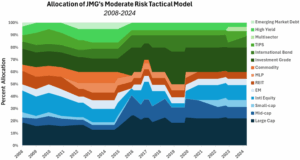
Here is a chart which highlights how JMG’s moderate portfolio allocation has changed over time.

Tax Management
Another reason you may see activity in your portfolio is tax management. Examples of this include:
- Tax Loss Harvesting – By realizing losses, when appropriate, your advisor can postpone tax consequences and optimize portfolio management.
- Moving between tax-exempt and taxable bonds – As yields on municipal bonds vary over time relative to taxable bond yields, and your personal tax rate changes, we seek to optimize the after-tax return based on the relative attractiveness of each type of bond income. As a result, your advisor may shift in or out of municipal bonds.
- Changing tax rates – Your advisor may choose to proactively realize gains due to changes in tax rates – either due to changes in tax law or changes in your situation.
- Asset location – As your tax situation changes, we evaluate adjusting how your assets are allocated across your accounts to improve the after-tax return.
Summary
A well-built portfolio supports client goals and uses diversification to optimize the risk and return tradeoff. As we have covered in this series of articles, our investment process has four steps: Client Analysis, Portfolio Design, Investment Selection, and Ongoing Management.
The bedrock of this process is the portfolio design which establishes a client’s strategic allocation and maps this allocation to specific underlying sub asset classes. We enhance this portfolio structure through security selection, and through ongoing management including tactical shifts, tax management, and thoughtful rebalancing.
The result may look simple, but your portfolio is the result of considerable analysis and ongoing due diligence.
Recognizing that each client is different, the JMG Investment Committee provides an overall framework for investing, while our advisors may adjust your portfolios to your unique circumstances. The ultimate portfolios in turn help you to meet your goals and integrate with your financial plan to reduce your income and estate taxes.
Hopefully this series of articles helps explain how JMG’s investment process is designed to establish a strategic approach that supports your objectives, implements your portfolio in a way which is consistent with your financial plans, reflects your tax considerations, and adapts to changing economic, market, and regulatory conditions to optimize your outcomes.
Please reach out to your JMG Financial Advisor if you have any questions.
Important Disclosure
Please remember that past performance may not be indicative of future results. Different types of investments involve varying degrees of risk, and there can be no assurance that the future performance of any specific investment, investment strategy, or product (including the investments and/or investment strategies recommended or undertaken by JMG Financial Group Ltd. (“JMG”), or any non-investment related content, made reference to directly or indirectly in this writing will be profitable, equal any corresponding indicated historical performance level(s), be suitable for your portfolio or individual situation, or prove successful. Due to various factors, including changing market conditions and/or applicable laws, the content may no longer be reflective of current opinions or positions. Moreover, you should not assume that any discussion or information contained in this writing serves as the receipt of, or as a substitute for, personalized investment advice from JMG. To the extent that a reader has any questions regarding the applicability of any specific issue discussed above to his/her individual situation, he/she is encouraged to consult with the professional advisor of his/her choosing. JMG is neither a law firm, nor a certified public accounting firm, and no portion of the content provided in this writing should be construed as legal or accounting advice. A copy of JMG’s current written disclosure Brochure discussing our advisory services and fees is available upon request. If you are a JMG client, please remember to contact JMG, in writing, if there are any changes in your personal/financial situation or investment objectives for the purpose of reviewing/evaluating/revising our previous recommendations and/or services, or if you would like to impose, add, or to modify any reasonable restrictions to our investment advisory services. JMG shall continue to rely on the accuracy of information that you have provided.
To the extent provided in this writing, historical performance results for investment indices and/or categories have been provided for general comparison purposes only, and generally do not reflect the deduction of transaction and/or custodial charges, the deduction of an investment management fee, nor the impact of taxes, the incurrence of which would have the effect of decreasing historical performance results. It should not be assumed that your account holdings correspond directly to any comparative indices. Indices are not available for direct investment.
Market Segment (index representation) as follows: U.S. Large Cap (S&P Total Return); U.S. Mid-Cap (Russell Midcap Index Total Return); Foreign Developed (FTSE Developed Ex U.S. NR USD); Emerging Markets (FTSE Emerging NR USD); U.S. REITs (FTSE NAREIT Equity Total Return Index); Foreign REITs (FTSE EPRA/NAREIT Developed Real Estate Ex U.S. TR); U.S Bonds (Bloomberg US Aggregate Bond Index); U.S. TIPs (Bloomberg US Treasury Inflation-Linked Bond Index); Foreign Bond (USD Hedged) (Bloomberg Global Aggregate Ex US TR Hedged); Municipal Bonds (Bloomberg US Municipal Bond Index); High Yield Bonds (Bloomberg US Corporate High Yield Index).