

Market Volatility and Diversification
INVESTMENT COMMITTEE COMMENTARY July 2026
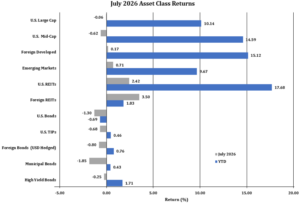
The U.S. stock market in July continued the rotation from mega-tech and artificial intelligence driven stocks to an expansion in overall market breadth. Coming off a robust second quarter that saw equities touch record territory, July witnessed a shift away from mega-cap technology toward blue-chip value, small-cap equities, and equal-weighted indices. An end-of-the-month rally helped the markets, which ultimately ended July with mixed results. For the month, the S&P 500 fell slightly by -0.1%.
July technology sector performance and volatility may have been influenced by the activities of Situational Awareness (SA), an aggressive AI-focused hedge fund founded by OpenAI employee Leopold Aschenbrenner. Following extraordinary gains earlier in 2026, the fund was reportedly forced to liquidate portions of its highly leveraged positions in AI related stocks during July. Financial Times reported that Citadel acquired a significant share of these holdings. While the extent of the impact on AI-related stocks remains unclear, the rapid liquidation may have contributed to short-term volatility.
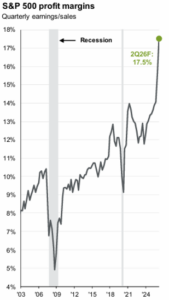
More broadly, according to FactSet, with 27% of S&P 500 companies reporting, 86% reported a positive earnings per share (EPS) surprise and 80% reported revenue above expectations. Through the second quarter, the earnings growth rate for the S&P 500 was 38%, which is the highest earnings growth rate reported by the index since the third quarter of 2021 (40%). Within the S&P 500, nine sectors reported higher earnings at the end of July compared to their respective June estimates.
July saw a pivotal transition for crude oil markets, defined by extreme volatility as prices whipsawed between temporary optimism over Middle East diplomacy and the ramping up of hostilities. Following months of wartime premiums and severe supply disruption through the Strait of Hormuz, crude oil prices experienced a sharp multi-week collapse in early July before mounting a mid-month rally that carried through the remainder of the month.
The U.S. bond market was marked by a sharp surge in Treasury yields to new highs for the year, driven by a hawkish Federal Reserve, persistent inflation, labor market strength, and resilient economic data. Short-term yields rose in anticipation of a potential Fed rate hike, while long-term yields trended higher. The yield on 10-year Treasuries rose from 4.44% to 4.75%. With increasing yields, fixed income benchmark indexes fell including the Bloomberg U.S. Aggregate Bond Index (AGG) which returned -1.3% for the month. When considering this performance, it is important to keep in mind the role of fixed income as a stabilizer during equity downturns. In addition, higher current yields point to higher go forward returns for the asset class.

Market Volatility and Diversification
The last several months reminded investors that markets often face competing narratives at the same time. Geopolitical tensions in the Middle East periodically resurfaced, inflation remained above the Federal Reserve’s target, and bond markets wrestled with the prospect of higher-for-longer interest rates. Throw in inflation, the SpaceX initial public offering (IPO) and oil prices, and such competing uncertainties bring market volatility. Yet despite these headwinds, strong corporate earnings, resilient economic growth, and continued investment in AI infrastructure helped support risk assets and reinforce the constructive outlook for long-term investors. On the following chart, JP Morgan Asset Management reports strong forward S&P 500 earnings growth and improving profit margins.


Despite a modest pullback in the S&P 500 during July, the broader story was encouraging as market gains expanded beyond a handful of large technology companies into areas such as value stocks, small-cap stocks, and a wider range of industries. While bond markets faced pressure from rising interest rates and higher Treasury yields, bonds continue to serve an important role within a diversified portfolio. Beyond generating income, fixed income investments can help dampen overall portfolio volatility, provide liquidity during periods of market stress, and offer a source of capital that can be rebalanced into equities when opportunities arise.
Although bonds and stocks may occasionally decline at the same time, high-quality fixed income has historically provided diversification benefits over full market cycles and remains a critical component of a disciplined investment strategy. With yields now significantly higher than they were just a few years ago, investors are being compensated more attractively for owning bonds, reinforcing their value as both an income-producing asset and a portfolio stabilizer.
While investors experienced continued volatility across stocks, bonds, and energy markets, the underlying fundamentals of the economy and corporate America remained resilient. For long-term investors, broad diversification continues to be important, as leadership shifts across asset classes and sectors create opportunities beyond the market’s largest companies.
In summary, the market’s ability to remain resilient despite war, inflation, and higher interest rates reflects the strength of the underlying economy and corporate earnings. While headlines will continue to create volatility, long-term drivers of returns remain intact, which is why maintaining a diversified and disciplined investment approach can be an effective path forward.
If you have any questions or wish to review your portfolio asset allocations, please consult your JMG Advisor.
Important Disclosure
Please remember that past performance may not be indicative of future results. Different types of investments involve varying degrees of risk, and there can be no assurance that the future performance of any specific investment, investment strategy, or product (including the investments and/or investment strategies recommended or undertaken by JMG Financial Group Ltd. (“JMG”), or any non-investment related content, made reference to directly or indirectly in this writing will be profitable, equal any corresponding indicated historical performance level(s), be suitable for your portfolio or individual situation, or prove successful.
This content is provided for educational purposes only. Due to various factors, including changing market conditions and/or applicable laws, the content may no longer be reflective of current opinions or positions. Moreover, you should not assume that any discussion or information contained in this writing serves as the receipt of, or as a substitute for, personalized investment advice from JMG. To the extent that a reader has any questions regarding the applicability of any specific issue discussed above to his/her individual situation, he/she is encouraged to consult with the professional advisor of his/her choosing. JMG is neither a law firm, nor a certified public accounting firm, and no portion of the content provided in this writing should be construed as legal or accounting advice.
A copy of JMG’s current written disclosure Brochure discussing our advisory services and fees is available upon request. If you are a JMG client, please remember to contact JMG, in writing, if there are any changes in your personal/financial situation or investment objectives for the purpose of reviewing/evaluating/revising our previous recommendations and/or services, or if you would like to impose, add, or to modify any reasonable restrictions to our investment advisory services. JMG shall continue to rely on the accuracy of information that you have provided.
To the extent provided in this writing, historical performance results for investment indices and/or categories have been provided for general comparison purposes only, and generally do not reflect the deduction of transaction and/or custodial charges, the deduction of an investment management fee, nor the impact of taxes, the incurrence of which would have the effect of decreasing historical performance results. It should not be assumed that your account holdings correspond directly to any comparative indices. Indices are not available for direct investment.
Market Segment (index representation) as follows: U.S. Large Cap (S&P Total Return); U.S. Mid-Cap (Russell Midcap Index Total Return); Foreign Developed (FTSE Developed Ex U.S. NR USD); Emerging Markets (FTSE Emerging NR USD); U.S. REITs (FTSE NAREIT Equity Total Return Index); Foreign REITs (FTSE EPRA/NAREIT Developed Real Estate Ex U.S. TR); U.S Bonds (Bloomberg US Aggregate Bond Index); U.S. TIPs (Bloomberg US Treasury Inflation-Linked Bond Index); Foreign Bond (USD Hedged) (Bloomberg Global Aggregate Ex US TR Hedged); Municipal Bonds (Bloomberg US Municipal Bond Index); High Yield Bonds (Bloomberg US Corporate High Yield Index).