

Kevin Warsh at Jackson Hole: Reform, Not Signaling
INVESTMENT COMMITTEE COMMENTARY August 2026
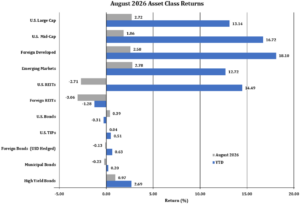
Wall Street enjoyed a solid month in August, despite periodic volatility. Stocks overcame inflation concerns, a gradually cooling labor market, rising Treasury yields, monetary policy uncertainty, and ongoing geopolitical tensions in the Middle East to finish the month higher. The markets focused on strong corporate earnings, softening inflation data, and investor optimism surrounding artificial intelligence (AI). The S&P 500 reached an all-time high in early August, only to slide marginally lower later in the month, while gaining 2.7% for the month.
Treasury yields generally held steady for the month but with some upward pressure on long-term Treasuries yields. Total returns were modestly positive in most fixed income sectors. Bonds reacted to a Federal Reserve (Fed) rate hold, cooling inflation that remained above the Fed target, geopolitical hostilities that influenced oil prices, and the recent trade fallout between the U.S. and Canada. The yield on 10-year Treasuries was flat in August at 4.75%. Fixed income benchmark indexes produced mixed returns in August including the Bloomberg U.S. Aggregate Bond Index (AGG) which returned 0.4% for the month.
With strong year-to-date gains, equity REITs had outperformed earlier in 2026. However, the more income-oriented REITs sector is more vulnerable to pullbacks from higher interest rates and Fed policy uncertainty. In August, while broader equities advanced higher, interest rates, sector rotation, and profit-taking contributed to negative REIT returns for the month.

Kevin Warsh at Jackson Hole: Reform, Not Signaling
While interest rates were relatively flat in August, rates have increased in recent months. Concerns continue over both short-term and long-term interest rates related to future inflation, government spending, sustaining economic growth from new AI technologies and the prospects for the Fed to raise the fed funds rate in 2026. With this backdrop, the Jackson Hole (Wyoming) Economic Symposium was held in August. This symposium is an annual three-day conference hosted by the Federal Reserve Bank of Kansas City, bringing together central bankers, economists, and policymakers to discuss global economic and financial policy issues. The event is designed to foster open discussion on long-term economic and policy issues of mutual concern. The keynote speech was made by new Fed Chair, Kevin Warsh.
In his address, Warsh presented a more restrained and principles-based approach to monetary policy. He argued that forward guidance has “overstayed its welcome” outside genuine crises because repeated signals about future policy can constrain the Fed, distort market prices, and create a “hall of mirrors” in which markets follow the Fed while the Fed reads those same markets. Warsh instead favors a quieter central bank that explains its objectives and decisions but does not pre-commit to a path for interest rates.
The symposium theme was “Financial Innovation: Implications for Payments and Policy”. Warsh was optimistic that artificial intelligence could raise productivity and potential economic growth. However, he emphasized that policymakers do not yet know the timing, scale, or distribution of those gains. On current conditions, he judged the labor market to be broadly consistent with full employment while inflation remained too high and broad financial conditions were not clearly restrictive. Warsh’s message was perceived as more hawkish but not committing to a specific decision. The Fed’s near-term focus will remain on restoring price stability. Higher short-term interest rates could be warranted if underlying inflation does not move clearly and sufficiently toward 2%.
Warsh outlined seven key monetary policy principles.
- Use timely, actionable data – Policy should reflect current trends rather than stale releases or isolated data points; policymakers must distinguish yesterday’s news from today’s economy.
- Assess demand relative to supply – The Fed should aim to keep aggregate demand broadly aligned with aggregate supply, while recognizing that supply capacity can only be estimated and is inherently uncertain.
- Treat 2% inflation as a firm target – The 2% PCE objective is fixed, and price stability will not necessarily return on its own; the Fed is responsible for delivering stable prices. (PCE stands for the Personal Consumption Expenditures Price Index, the Fed’s preferred measure of inflation. “Core PCE” excludes food and energy prices to highlight the underlying inflation trend.)
- Pursue both sides of the dual mandate – Maximum employment and price stability are not opposing goals over the medium-term because persistent inflation ultimately harms jobs, incomes, and economic prosperity.
- Rely primarily on short-term interest rates – The policy rate should remain the principal monetary tool, while unconventional measures such as large-scale asset purchases should be reserved for genuine crises and otherwise used sparingly, if at all.
- Remember that money matters – Monetary and credit growth, including money created by the central bank and banking system (M2), can provide important information about inflation and financial conditions and should not be ignored.
- Results over rhetoric – Credibility should rest on achieving the Fed’s mandate, not on explanations, forecasts, or forward guidance. The Fed should communicate purposefully, remain adaptable, and be judged by outcomes.
Investment Implications
The Federal Reserve may provide less advance guidance about future interest-rate decisions, which could result in periods of increased market volatility. However, the Fed’s continued commitment to price stability remains important for the long-term health of the economy. For investors, the key takeaway is to maintain a diversified portfolio aligned with long-term goals rather than reacting to individual economic reports or Federal Reserve meetings.
If you have any questions or wish to review your portfolio asset allocations, please consult your JMG Advisor.
Important Disclosure
Please remember that past performance may not be indicative of future results. Different types of investments involve varying degrees of risk, and there can be no assurance that the future performance of any specific investment, investment strategy, or product (including the investments and/or investment strategies recommended or undertaken by JMG Financial Group Ltd. (“JMG”), or any non-investment related content, made reference to directly or indirectly in this writing will be profitable, equal any corresponding indicated historical performance level(s), be suitable for your portfolio or individual situation, or prove successful.
This content is provided for educational purposes only. Due to various factors, including changing market conditions and/or applicable laws, the content may no longer be reflective of current opinions or positions. Moreover, you should not assume that any discussion or information contained in this writing serves as the receipt of, or as a substitute for, personalized investment advice from JMG. To the extent that a reader has any questions regarding the applicability of any specific issue discussed above to his/her individual situation, he/she is encouraged to consult with the professional advisor of his/her choosing. JMG is neither a law firm, nor a certified public accounting firm, and no portion of the content provided in this writing should be construed as legal or accounting advice.
A copy of JMG’s current written disclosure Brochure discussing our advisory services and fees is available upon request. If you are a JMG client, please remember to contact JMG, in writing, if there are any changes in your personal/financial situation or investment objectives for the purpose of reviewing/evaluating/revising our previous recommendations and/or services, or if you would like to impose, add, or to modify any reasonable restrictions to our investment advisory services. JMG shall continue to rely on the accuracy of information that you have provided.
To the extent provided in this writing, historical performance results for investment indices and/or categories have been provided for general comparison purposes only, and generally do not reflect the deduction of transaction and/or custodial charges, the deduction of an investment management fee, nor the impact of taxes, the incurrence of which would have the effect of decreasing historical performance results. It should not be assumed that your account holdings correspond directly to any comparative indices. Indices are not available for direct investment.
Market Segment (index representation) as follows: U.S. Large Cap (S&P Total Return); U.S. Mid-Cap (Russell Midcap Index Total Return); Foreign Developed (FTSE Developed Ex U.S. NR USD); Emerging Markets (FTSE Emerging NR USD); U.S. REITs (FTSE NAREIT Equity Total Return Index); Foreign REITs (FTSE EPRA/NAREIT Developed Real Estate Ex U.S. TR); U.S Bonds (Bloomberg US Aggregate Bond Index); U.S. TIPs (Bloomberg US Treasury Inflation-Linked Bond Index); Foreign Bond (USD Hedged) (Bloomberg Global Aggregate Ex US TR Hedged); Municipal Bonds (Bloomberg US Municipal Bond Index); High Yield Bonds (Bloomberg US Corporate High Yield Index).